Have you ever woken up at a safari lodge in Uganda just before sunrise and heard the forest, wetland, or surrounding hills suddenly come alive with birdsong?
One bird begins calling. Another answers from somewhere in the trees. Soon, whistles, chirps, songs, trills, and contact calls seem to come from every direction.
This spectacular natural soundtrack is known as the dawn chorus.
But why do birds chirp in the morning? Why are birds particularly vocal around sunrise, and why is early morning considered one of the best times for birdwatching in Uganda?
The answer is linked to bird communication, territory, courtship, breeding, social interaction, and the environmental conditions around sunrise.
For travelers exploring Uganda, the dawn chorus is more than something you hear from your lodge. It is an introduction to Uganda's extraordinary biodiversity before the day's safari activities even begin.
The dawn chorus is the period around sunrise when many bird species become especially vocal.
Depending on the habitat, weather, season, and species, birds may begin calling before sunrise and continue their vocal activity after the first light appears.
The sequence can be fascinating. A few birds begin calling while it is still relatively dark. As dawn approaches, more species join in until the surrounding landscape is filled with different sounds.
In Uganda, every habitat has its own version of the dawn chorus.
A morning in Bwindi Impenetrable Forest can sound completely different from one beside Lake Bunyonyi. The birdlife around Mabamba Wetland has a different character from the woodland and savannah of Queen Elizabeth National Park, while Kibale Forest offers the opportunity to hear numerous forest species among the dense vegetation.
For birdwatchers, the dawn chorus is one of the most immersive ways to experience Uganda's natural environment.
Birds do not simply chirp in the morning because they have just woken up. Their morning songs and calls can serve several important biological purposes.
Birds rely heavily on sound to communicate. Depending on the species and situation, a vocalization can help birds maintain contact with a mate or group, announce their presence, warn of danger, coordinate movements, or communicate with neighboring birds.
Because different species have different calls and songs, an experienced birdwatcher can sometimes identify a bird without seeing it. This is particularly useful in Uganda's dense tropical forests, where vegetation can make visual identification challenging.
One of the major functions of birdsong is territorial communication.
A territorial bird may sing to signal that a particular area is occupied. The song can communicate information to competing birds without requiring a physical confrontation.
A suitable territory can provide food, water, nesting locations, shelter, and access to potential mates.
This makes territory particularly important during breeding periods, when birds may become more vocal.
Birdsong can also be an important part of courtship and mate attraction.
In many bird species, males use songs to advertise their presence and attract females. Some species have remarkably complex songs, while others rely on shorter or simpler vocalizations.
During a guided Uganda birding safari, your guide may identify a bird from its song before you have located it with binoculars.
Learning to recognize birds by sound adds another dimension to birdwatching. Instead of simply searching the trees for movement, you begin to understand the landscape through its sounds.
Some birds begin vocalizing while it is still dark, which raises another interesting question: why do birds sing before sunrise?
There is no single explanation that applies equally to every species, but several factors can make the early morning an effective time for vocal communication.
Before sunrise, there may be relatively little background noise from people, vehicles, and other human activity. Wind can also be calmer in some environments, allowing sounds to travel effectively.
At the same time, there may not yet be enough light for many birds to forage efficiently.
This creates a period when communicating can be particularly useful.
As daylight increases, birds often become increasingly active in searching for food, moving through vegetation, and carrying out other daily activities.
If you are planning a birding safari in Uganda, an early start can make a major difference.
Birds are often particularly active and vocal during the first hours of the day. This means birdwatchers can locate species through their calls before attempting to find them visually.
The cooler morning temperatures can also make walking through forests, wetlands, and other habitats more comfortable than during the hotter parts of the day.
This is why many professional birding excursions in Uganda begin around sunrise.
Your guide may stop regularly, listen carefully, identify a distant call, and then help you locate the bird with binoculars.
Sometimes you may hear several species before seeing a single one.
That is part of the challenge—and the enjoyment—of birdwatching.
Uganda is particularly interesting for birdwatchers because of its remarkable range of habitats.
The country contains:
Tropical forests
Highland forests
Wetlands and papyrus swamps
Lakes and rivers
Grasslands
Savannah
Woodland
Agricultural landscapes
Mountain ecosystems
Each habitat supports different bird communities.
This means a Uganda birding safari can offer a surprisingly varied experience, with completely different species and sounds from one destination to another.
For travelers combining birdwatching with wildlife and primate experiences, Uganda also makes it possible to include birding alongside chimpanzee trekking, gorilla trekking, game drives, boat safaris, and wetland excursions.
Located near Entebbe, Mabamba Wetland is one of Uganda's most interesting destinations for birdwatchers.
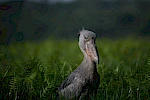
The wetland is particularly famous for the opportunity to search for the Shoebill, one of Africa's most distinctive birds.
Exploring Mabamba by traditional canoe in the early morning provides an opportunity to experience the wetland at its most active. As light spreads across the papyrus channels, different birds begin calling and moving through the vegetation.
For travelers arriving at Entebbe International Airport, Mabamba can also be incorporated into a wider Uganda birding itinerary before continuing to other destinations.
Kibale National Park is internationally known for its chimpanzees, but it is also an excellent destination for forest birding.
Early morning is an especially rewarding time to explore the forest because many birds are active and vocal.
The nearby Bigodi Wetland Sanctuary adds another habitat to the experience. Here, visitors can explore a wetland environment on foot with a local guide while looking and listening for different bird species.
Combining Kibale Forest with Bigodi provides an opportunity to experience the contrast between tropical forest and wetland ecosystems within the same region.
For travelers interested in both primates and birds, Kibale can therefore become an important part of a Uganda birding and chimpanzee safari.
The birding experience changes dramatically when you move from tropical forest into the open landscapes of Queen Elizabeth National Park.
The park combines savannah, woodland, wetlands, lakes, and the Kazinga Channel, creating a diverse environment for wildlife and birdlife.
An early morning game drive can therefore serve two purposes.
While searching for elephants, lions, buffaloes, antelopes, and other wildlife, you can also watch for birds moving through the grassland and woodland.
Later in the day, a Kazinga Channel boat safari offers another perspective. The waterway and its surrounding vegetation support numerous water-associated birds, while hippos, crocodiles, elephants, and other wildlife can often be seen along the channel.
For many international visitors, Bwindi Impenetrable Forest is synonymous with mountain gorilla trekking.
However, Bwindi is also an important destination for forest birdwatching.
The dense vegetation means that some birds can be difficult to see. You may hear a distinctive call from somewhere in the canopy without immediately knowing exactly where the bird is.
This is where an experienced birding guide can be particularly valuable.
Rather than relying exclusively on sight, guides listen for calls, identify likely species, and help visitors search the vegetation and canopy.
For travelers combining Uganda gorilla trekking with birdwatching, Bwindi provides an opportunity to experience the forest from a completely different perspective.
Surrounded by the rolling hills and terraced landscapes of southwestern Uganda, Lake Bunyonyi offers a quieter birding experience.
The lake, islands, surrounding hills, cultivated slopes, and vegetation create a variety of habitats for birds.
Early morning is an excellent time to simply slow down and listen.
Instead of the sounds of a busy city, you may hear birds calling across the water, from nearby vegetation, or from the hills surrounding the lake.
For travelers visiting Bwindi, spending time around Lake Bunyonyi can provide a peaceful complement to the intensity of a gorilla trek.
One of the most interesting things about a guided birding safari is watching your guide stop, remain completely still, and listen.
To a first-time birdwatcher, it may seem like nothing is happening.
But the guide may already be identifying several species.
Dense forests can make visual identification difficult. Birds can remain hidden behind leaves, move rapidly between branches, or stay high in the canopy.
Their voices, however, can reveal where they are.
Experienced Ugandan bird guides develop a detailed knowledge of bird calls and songs. Once a species has been identified by sound, the guide can help you locate it visually using binoculars.
This is why birding by ear is such an important skill for serious birdwatchers.
Birdwatchers often distinguish between a bird song and a bird call, although the distinction is not always absolute.
Songs are generally more complex vocalizations and are often associated with activities such as attracting mates and defending territories.
Calls are frequently shorter and can serve many purposes, including warning other birds of danger, maintaining contact with a group, or coordinating movements.
Different species have developed different vocal communication systems.
So when you hear birds chirping outside your safari lodge at sunrise, you could actually be listening to several different forms of communication happening simultaneously.
If your main goal is to experience the dawn chorus, plan to be ready before sunrise.
There is no single universal time because sunrise changes throughout the year and conditions vary between locations.
Weather, habitat, season, and the species you are targeting can all affect bird activity.
On a professionally organized Uganda birding safari, your guide can recommend the appropriate departure time for each location.
For forest birding, starting early is particularly valuable because the first hours of daylight can provide excellent opportunities to hear and locate birds.
You do not need a huge amount of equipment to enjoy birdwatching in Uganda, but a few items can make the experience considerably better.
Useful birdwatching equipment includes:
Binoculars
A camera with a suitable telephoto or zoom lens
Comfortable walking shoes
Lightweight, breathable clothing
Insect repellent
Drinking water
A light rain jacket
Bird identification app or field guide
Notebook or phone for recording sightings
A good pair of binoculars is particularly useful in forest habitats, where many birds remain high in the canopy or partially hidden by vegetation.
One of the great advantages of a Uganda safari is that birdwatching does not have to be a separate activity.
Birds are everywhere.
You can encounter interesting birdlife while travelling between destinations, during a game drive, beside a lake, on a forest walk, or while relaxing at your accommodation.
A carefully designed itinerary can combine birding with Uganda's famous primate and wildlife experiences.
For example:
Mabamba Wetland → Shoebill tracking → Kibale Forest birding → chimpanzee trekking → Bigodi Wetland Sanctuary → Queen Elizabeth National Park → Kazinga Channel boat safari → Ishasha wildlife viewing → Bwindi gorilla trekking → Lake Bunyonyi
This combination allows travelers to experience several of Uganda's major ecosystems in a single journey.
Uganda is particularly attractive to travelers who do not want to choose between birds, primates, and traditional safari wildlife.
A single journey can include Shoebill tracking, tropical forest birding, chimpanzee trekking, wetland walks, savannah game drives, boat safaris, gorilla trekking, and time around Lake Bunyonyi.
The result is a much broader wildlife experience.
You might begin one morning quietly listening for forest birds in Kibale, spend another searching for hippos and waterbirds along the Kazinga Channel, and later trek through Bwindi in search of mountain gorillas.
For international travelers, this variety is one of the attractions of planning a dedicated Uganda birding and wildlife safari rather than a conventional game-drive itinerary.
A safari is not only about the animals you see.
It is also about the sounds you hear.
The rustle of vegetation.
The distant call of a monkey.
The splash of a hippo.
The sound of insects beginning their morning activity.
And, above all, the birds announcing the arrival of another day.
When you wake before sunrise in Uganda, the wilderness may already be active.
The birds are communicating, defending territories, searching for mates, maintaining contact with one another, and preparing for the day ahead.
That is the dawn chorus.
At Galactic Safaris, we design private Uganda safaris for travelers who want to experience the country's wildlife, landscapes, forests, wetlands, and local communities at their own pace.
Our Uganda itineraries can combine birdwatching with gorilla trekking, chimpanzee trekking, game drives, boat safaris, wetland walks, and cultural experiences.
For dedicated birdwatchers, we can build an itinerary around specific habitats and target species. For travelers who simply want to add birding to a gorilla or wildlife safari, birdwatching can be incorporated naturally into the journey.
Whether your dream is to search for a Shoebill at Mabamba Wetland, listen to forest birds in Kibale, explore the wetlands of Bigodi, watch waterbirds along the Kazinga Channel, or combine birding with gorilla trekking in Bwindi, Uganda offers an extraordinary range of experiences.
Birds chirp, sing, and call in the morning for several reasons, including communicating with other birds, defending territories, attracting mates, maintaining contact, and responding to their surroundings.
Sunrise provides environmental conditions that can make vocal communication effective. There may be less background noise and, before full daylight, limited opportunities for some birds to forage. Many species therefore become highly vocal around dawn.
The dawn chorus is the period around sunrise when many birds sing and call, often creating a layered chorus of different species across a forest, wetland, woodland, or other habitat.
Early morning is often one of the most productive times for birdwatching because many birds are active and vocal. The cooler temperatures can also make walking more comfortable.
Popular birdwatching destinations in Uganda include Mabamba Wetland, Kibale National Park, Bigodi Wetland Sanctuary, Queen Elizabeth National Park, Bwindi Impenetrable Forest, and Lake Bunyonyi, among many other locations.
Yes. Birdwatching can be incorporated into a broader Uganda itinerary that includes gorilla trekking in Bwindi, chimpanzee trekking in Kibale, game drives, boat safaris, and other wildlife experiences.
Mabamba Wetland near Entebbe is one of the best-known places in Uganda for searching for the Shoebill, with canoe excursions providing access to the wetland channels.
So, why do birds chirp in the morning?
Because dawn is an important period of communication.
Birds sing and call to establish territories, attract mates, communicate with partners and groups, warn of danger, and interact with other birds. The relatively quiet conditions around sunrise can make this an effective time for vocal communication.
In Uganda, the experience is particularly memorable because every ecosystem has its own soundtrack.
From Mabamba Wetland and its Shoebills, to the tropical forests of Kibale and Bwindi, the savannah of Queen Elizabeth National Park, and the peaceful shores of Lake Bunyonyi, the country's birdlife is an integral part of the safari experience.
So the next time you wake up on safari and hear birds singing outside your lodge, don't rush to get ready.
Stay still for a moment.
Listen carefully.
Uganda's wilderness is already awake.
Sat 19 Sep 2026
Mafia Island, Tanzania , is one of the most beautiful and peaceful destinations on the Tanzanian coast. Located in the Indian Ocean, south of Zanzibar and off...
さらに詳しくSat 19 Sep 2026
If you’re planning an adventure in Rwanda, the Congo Nile Trail should be at the top of your list. Although Rwanda is famously known for its gorilla trekking...
さらに詳しく